The Drying Order: Where Wet Clothes Should Actually Land This Winter
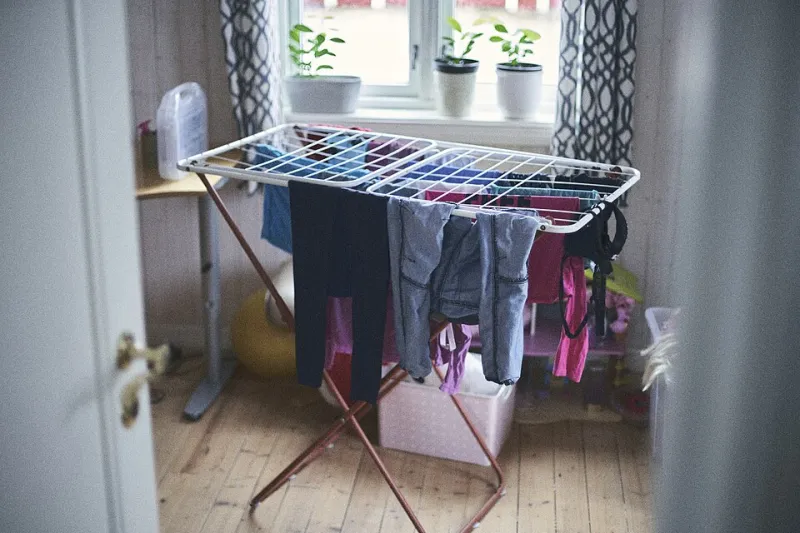
Photo: Øyvind Holmstad, CC BY-SA 4.0, via Wikimedia Commons
There is a particular moment in a British winter when the machine beeps, you open the door, and you're faced with a dense, cold bundle that needs to be somewhere. The instinct is the radiator. Resist it. A radiator is a hot surface with no airflow and no route out for moisture, which makes it the fastest known method for turning a favourite jumper into a smaller, denser, sadder jumper. It's also the quickest way to a windowsill running with condensation and a black patch in the corner by February.
Drying clothes indoors in November isn't really a battle against water. It's a negotiation with air. The water has to go somewhere, and the whole job is giving it a route out of the room before it settles into your walls, your curtains and your lungs. Get that right and most washes dry themselves almost quietly. Get it wrong and you end up with clammy clothes, a damp flat and that faint swimming-pool smell that never quite leaves a wool coat.
Here's the order of work we come back to every year.
Pull the easy water out first
The cheapest drying is the drying you do before anything goes near a rack. If your machine has a spin-only setting, use it. An extra ten minutes in the drum lifts out water that would otherwise sit in the middle of a towel for hours. It also cuts the total drying time more than any gadget you can buy.
Then shake. Properly. Take each item by the shoulders or the waistband and snap it out two or three times. A garment that goes onto a hanger crumpled will dry crumpled, and no amount of steaming later quite undoes it.
For knitwear there's one extra step worth the bother: lay a bath towel flat, put the jumper on top, roll the whole thing up from one end, then press down along the roll with your forearms or your knees. You'll be surprised how much water comes out. The jumper goes onto the rack noticeably lighter and hours ahead of schedule.
Three lanes, and nothing in between
Sort the wet wash into three lanes rather than draping it wherever there's space.
Hanging. Shirts, tees, dresses, trousers, anything with a bit of structure or a seam that wants to fall straight. On hangers, spaced at least a hand's width apart. Trousers folded over the bar rather than pegged by the waistband — pegs leave marks that never come out of a dark chino.
Flat. Knitwear, anything wool, anything heavy when wet, anything ribbed. Flat drying is what keeps a jumper the length it was when you bought it. A mesh drying mat over the airer bars does the job; so does a clean towel on top of a rack, as long as air can still move underneath.
Shaped and pegged. Socks, underwear, gym kit, anything small. Peg from the hem rather than the waistband so the weight hangs downwards and the shape follows it, not against it.
What doesn't get a lane is the pile on the spare bed. Things left in a heap stay wet in the middle and dry at the edges, which is how you get a towel that smells of nothing much and a shirt collar that's gone faintly sour.
Airflow does the work, not heat
Heat without moving air just warms the outside of a garment and traps the damp inside it. What actually carries water away is air passing across the surface. So: leave a clear space around the airer — roughly a metre if you can manage it — and give the room a reason to move.
A fan on its lowest setting, pointed across the rack rather than at it, is genuinely one of the most effective things in the house. So is a dehumidifier running on its laundry setting in a closed room. A heated airer with a cover works on the same principle as a tiny greenhouse, but only if you leave gaps and don't zip it up like a suitcase.
And don't cram. Two half-full airers will beat one overloaded one every single time. It looks inefficient. It isn't.
The small-flat problem
If you're in a one-bed or a Victorian terrace with the washing machine in the kitchen, the limiting factor isn't space for the rack — it's the humidity. Warm, wet air has to leave the room or it will simply re-settle on the nearest cold surface, which is usually a window, an external wall or your coat hanging by the door.
So ventilate on a rhythm. Crack a window in the drying room for ten or fifteen minutes twice a day, even when it's cold out, and keep trickle vents open rather than sealed. Run the extractor fan in the bathroom if that's where the airer lives. Then shut the window again and let the room warm back up. Cold air coming in holds very little water; warming it up drops the relative humidity and gives your clothes somewhere to send their moisture.
What should never meet a radiator
Wool and cashmere will felt and shrink. Anything with elastane will lose its memory and go baggy at the knees. Printed tees will crack where the fabric stretches over a hot bar. Trainers will delaminate. A wool coat draped over a radiator for a night will come back with a shine you can't brush out.
If a radiator has to be involved, keep it to cotton bedding and bath towels, and only after a good spin and only with the door open and air moving. Everything else belongs on the rack, in the airflow, with time to spare.
A week that actually dries
Wash on a day you're in the house. Start early rather than at nine at night. Two loads a day, maximum, and get the last one onto the airer before four so it has the evening to work. Wear things more between washes — knitwear every five or six wears, jeans every ten — and you'll halve the problem before you've bought a single gadget.
And when the weather is genuinely hopeless, be honest about it. Bedding and towels through a laundrette dryer once a fortnight costs less than repainting a damp corner, and it saves the pieces that matter from a week of slow, mildewy air.