Hold the Line: How to Pick an Everyday Belt That Won’t Fold First
A belt is not really an accessory. It is infrastructure. When it works, you forget it exists; when it fails, you notice it every time you stand up, sit down or reach for a coat. The trouble is that most belts look broadly similar on a shelf. A strip of leather, a metal buckle, a few holes. The difference between one that lasts years and one that curls up after a few months is usually in the details you can check in the shop—or, if you are buying online, in the product photos and the returns policy.
At Bear Essentials, we are firmly in the camp of buying fewer things and wearing them properly. A belt is a good candidate for that approach. It gets handled every single day, it rubs against trouser loops and chair edges, and it takes the brunt of a winter coat being yanked on and off. So it is worth ten minutes of scrutiny before you hand over your money.
Start with the trousers, not the belt
The most useful thing you can do is take the trousers you actually wear with you. Not a pair you wish you wore. The jeans that fit, the chinos that get you through the week, the smart trousers for the office. Thread the belt through the loops before you even look in the mirror. Does it slide easily? Does it sit flat, or does it bunch? Is the width comfortable against your waistband, or does it feel like a strap from a rucksack?
This is the belt loop test in its simplest form. A belt should move through the loops without a fight and sit without twisting. If the loops are narrow and the belt is wide, you will spend the whole day persuading it to lie straight. If the belt is very thin, it may start to curl at the tail. The right width for most everyday trousers is roughly 3cm to 3.5cm; a wider 4cm belt can work well with denim or heavier casual trousers, but check the loops first. A belt that fits the loops is already halfway to earning its place.
Leather, bonded and the vague middle ground
Leather is the obvious choice for a belt that will age well, but the word on the label is not always the whole story. Full-grain and top-grain leathers are the ones to look for if you want something that softens and darkens with wear rather than peeling. Bonded leather is made from leather fibres glued together with a backing; it can look smart enough at first, but it is more prone to cracking and splitting, especially where the belt bends around the buckle and through the loops.
A practical shop-floor check is to look at the cut edge. On a solid leather belt, the edge should look dense and consistent, not fluffy or layered like a sandwich. If the edge is painted or coated, that is not automatically a bad thing—many good belts have sealed edges—but the coating should be neat and flexible, not thick and plasticky. Bend the belt gently in your hands. It should flex without feeling like a strip of cardboard. Too stiff and it will fight you; too floppy and it may stretch out of shape.
The buckle is where cheap belts give themselves away
A buckle does not need to be fancy. It needs to be solid, smooth and lined up properly with the holes. Give the prong a wiggle: it should move freely but not feel loose or flimsy. Look at the finish on the frame—plated zinc can look fine in the packet, but it may pit or flake where it rubs against the belt. Solid brass or stainless steel is a better bet if you want the hardware to outlast the leather.
Then look at the holes. They should be cleanly punched, not ragged, and ideally reinforced with stitching or a proper finish. A single row of five holes is standard, but check that the middle hole lines up with your usual waist measurement. If you are between holes on the tightest setting, the belt is too big. If you are already on the last hole, it is too small. You want to be somewhere in the middle, with room to adjust for a heavy lunch or a lighter pair of trousers.
Sizing for different rises
This is where many belt purchases go wrong. Your belt size is not the same as your waist size, and it is definitely not the same as the number on your jeans. Measure around the point where the trousers actually sit. A high-rise pair sits nearer the natural waist, so it usually needs a shorter belt. A low-rise pair sits further down the hips and will often need a longer one. If you wear both, do not assume one belt will do everything comfortably.
The simplest method is to measure an existing belt from the buckle to the hole you use most. That gives you a real-world number. If you are buying online, check whether the brand measures to the middle hole or the total length; the two can differ by several centimetres. And if you are buying in person, use the shop’s mirror properly: sit down, stand up, and see where the tail sits. A long tail flopping about is not just annoying—it will curl and wear faster.
Stitching, edges and the small signs of care
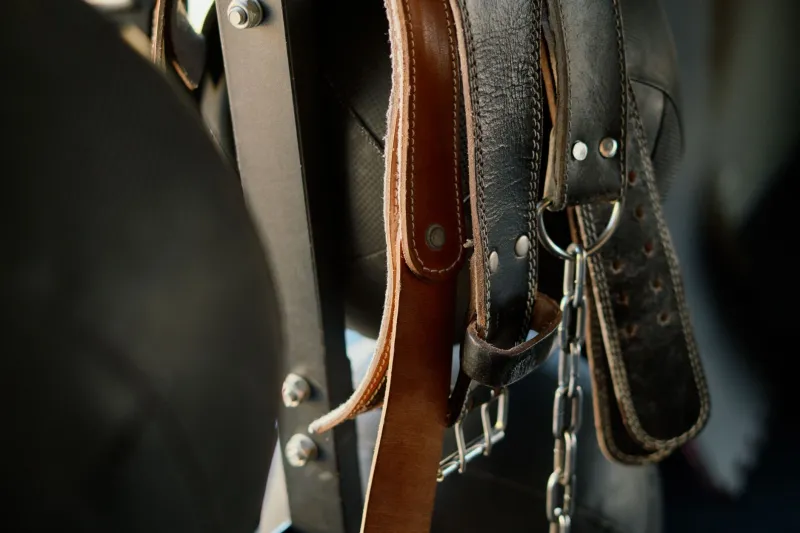
Run your thumb along the stitching. It should be even, tight and straight, with no loose threads or skipped sections. Decorative stitching is fine, but the functional stitching around the buckle and the keeper is what keeps the belt together. Check the keeper loop too—the small loop that holds the tail. It should be securely attached and made from a similar quality of leather, not a thin strip that will snap.
Look at the edge finishing again, this time where the belt bends. Cheap edges often crack first at the buckle fold. A well-finished edge will look sealed but still supple. If the belt has a lining, make sure it is stuck down flat, with no bubbles or lifting. These small checks take a minute, but they tell you more than the label ever will.
The keeper test
A belt that passes all of this should feel slightly boring in the best way. It should not need breaking in for weeks, and it should not demand special treatment. Wear it with your regular trousers, hang it loosely rather than coiled tightly, and let it dry naturally if it gets wet. A little leather conditioner now and then is fine, but most everyday belts need less fuss than people think.
If you are unsure between two belts, choose the one that feels more supple in the hand and has the cleaner edge. The buckle can be replaced; the leather cannot. And if the belt passes the loop test with the trousers you actually wear, you are already ahead of most of the belts on the high street. That is the Bear Essentials approach: buy the thing that does the job, then stop thinking about it.