A Hook by the Door: The Three-Scarf Rotation That Earns Its Keep
Most scarves fail for a boring reason: they are kept in the wrong place. They end up folded in a drawer under gloves, odd socks and a hat that never quite fits, while the coat you actually wear every morning hangs by the door with nothing to keep the wind off your neck. The fix is not another scarf. It is a tiny rotation that lives close to the coats and earns its place.
Three is a useful number for a British winter. One warm wool workhorse, one lighter layer for milder or transitional days, and one smarter option for town, evenings or anything that needs a bit more polish. That is enough to cover the coats most of us own without creating a drawer that bulges every time you open it.
Start with the coat rail, not the scarf drawer
Before buying anything, look at the coats you genuinely wear. Not the formal one at the back of the wardrobe, not the optimistic trench that is waiting for a different climate. The everyday waterproof, the wool overcoat, the padded jacket, the smart-ish coat for meals out. Those are the ones that need scarves.
A practical rotation usually looks like this: a neutral workhorse that sits well with your most-worn coat, a lighter scarf that adds a little contrast without bulk, and a darker or finer scarf that lifts a smarter coat. If your coats are mostly navy, charcoal, black or camel, this is straightforward. You do not need three scarves in three wildly different colours. You need three that work hard with what is already hanging up.
The workhorse: warm wool, plain enough to forget about
The first scarf should be the one you reach for on the sort of morning that makes you say a word you would not use in front of your mother. Lambswool or merino is a sensible place to start. It is warm without being stiff, and it usually drapes well enough to wrap once and tuck into a coat without a fight.
Look for a generous length and enough width to cover the gap at the neck. A scarf that is too short becomes a decorative collar rather than a warm one. A plain colour, a simple check or a quiet stripe will do more work than a bold pattern you have to dress around. This is the scarf that lives by the door from November to February.
When judging quality, ignore the label for a second and use your hands. The fabric should feel dense rather than loose, with a bit of substance when you bunch it up. Give it a gentle rub and see whether fibres start shedding immediately. Check the fringe and seams for neatness. A wool scarf does not need to be cashmere to be good, and it does not need to cost a fortune to last. Spend where warmth and durability matter, then wait for a sale if the price feels silly.
The middle layer: lighter, quieter, useful in real weather
The second scarf is the one people forget. It is not there for the coldest day. It is there for the damp, mild, indecisive weather that Britain does so well: the morning that starts cold, turns drizzly by lunch and ends with you carrying your coat over one arm.
A lighter wool, cotton blend or soft woven scarf works well here. It can sit under a coat without adding bulk, or loosen up when you go inside. Think of it as a bridge between seasons rather than a full winter barrier. A soft grey, muted olive, pale navy or gentle cream can lift a dark coat without shouting about it.
This is also the scarf to use when you want a bit of texture near your face. A subtle herringbone or brushed finish can make a plain waterproof jacket look less purely functional. The key is to keep it light enough that you do not overheat on the bus or in a warm café.
The smarter one: for town, evenings and coats with a bit of shape
The third scarf is not about being formal. It is about being pulled together. A finer wool, a wool-silk blend or a neatly finished scarf in a darker shade will work with a wool overcoat, a trench or the coat you keep for dinners and trips into town.
This is where a little contrast helps. If your everyday scarves are pale or neutral, the smarter one can be charcoal, deep green, burgundy or navy. If your coats are already dark, a finer scarf in a lighter shade can stop the whole outfit looking like a uniform. Keep the fringe neat and the pattern restrained. You want it to look deliberate, not like you grabbed the first thing off the hook.
Match scarves to coats without overthinking it
A simple rule: one scarf should blend with your most-worn coat, one should add a little contrast, and one should sit near your face in a colour you actually like. That is usually enough. Exact matching can look a bit forced, especially with checked coats or textured jackets. A scarf that is slightly lighter or darker than the coat is often more useful than one that matches perfectly.
Also think about bulk. A chunky scarf under a slim wool coat can make the neckline look crowded. A finer scarf under a padded jacket can disappear. Match the weight of the scarf to the weight of the coat, and you will wear both more often.
The bulging drawer problem
The reason three scarves work is not that three is a magic number. It is that a small rotation is visible, usable and easy to maintain. Once you have more than a handful, the good ones get buried. You buy another because you cannot find the one you want, and the drawer becomes a soft, tangled argument.
Try a simple one in, one out approach. If a new scarf comes in, an old one leaves: charity shop, clothing bank or a friend who will actually wear it. Keep the three in use near the coats, and store anything out of season separately. This is not minimalism for its own sake. It is just a way to make sure the scarves you own are the ones you wear.
Store them where they get worn
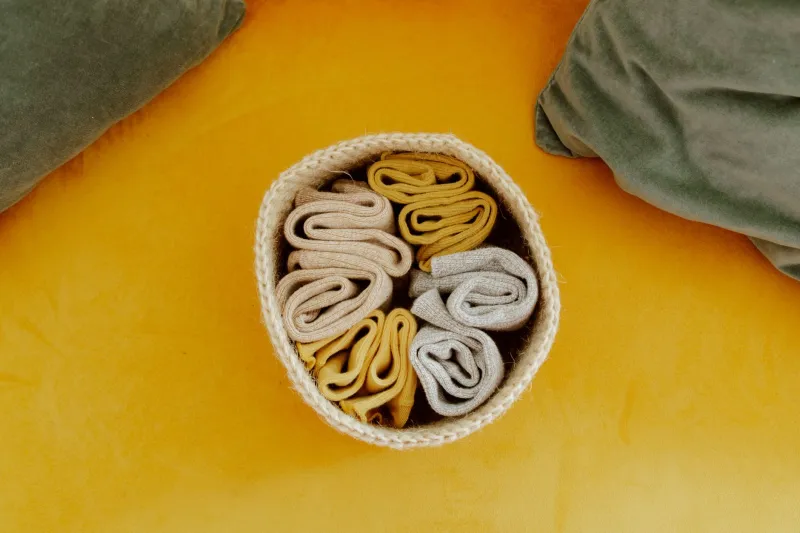
A hook or peg by the door is better than a drawer for the scarf you use daily. If you have space, a small basket on a hallway shelf also works. Fold the others loosely in a breathable cotton bag or a clean pillowcase, not compressed under heavy coats. Wool needs a little air.
Give them a gentle shake before putting them away, and follow the care label rather than guessing. Airing a scarf between wears does more for freshness than washing it constantly. If you have moths in the house, keep an eye on wool scarves and store them clean.
A small rotation in practice
On a wet Monday, take the lighter scarf and tuck it under a waterproof. On a properly cold Wednesday, the wool workhorse goes with the padded coat. On Saturday, when you are meeting friends in town, the smarter scarf goes with the overcoat and makes the whole thing look less accidental.
That is the quiet advantage of a three-scarf rotation. It removes a small decision from the morning, keeps the hallway calmer and makes every coat you own a little more useful. Not bad for three pieces of cloth and a hook by the door.