The Alteration Audit: How to Tell If a High-Street Buy Is Worth Ten Minutes With a Tailor
There is a particular kind of wardrobe disappointment that has nothing to do with quality. The fabric is decent, the colour works, the price was sensible — but the thing just hangs there. It looks like what it is: a purchase. A few centimetres in the right places can change that entirely. Fit is the cheapest luxury in clothing, and in the UK it is often available for the price of a couple of lunches.
But not every bargain deserves ten minutes with a needle. The smarter approach is to treat alterations as part of the buying decision, not an afterthought. Before you hand over your card, work out whether the garment is alteration-friendly. If it is, a £40 jacket can read like something far more considered. If it isn’t, you are simply paying twice for the same disappointment.
Start with the seam, not the label
Most of us are trained to look at fabric composition, brand names and price tags. A tailor looks at seams. Specifically, they look for room to move — literally. A garment with generous seam allowances can be taken in, let out slightly, or reshaped. A garment with narrow allowances and fused construction may have almost nowhere to go.
This is why two jackets at the same price can have very different futures. One might have a centre back seam that can be nipped in, sleeves that can be shortened from the cuff, and a hem with enough fabric to work with. Another might have glued edges, patterned fabric that will misalign if moved, and shoulders that were cut for a different skeleton entirely. The first is a candidate. The second is a donation waiting to happen.
You do not need to become a tailoring expert to spot the difference. Turn the garment inside out. Look at the side seams and the centre back seam. Can you see a clear allowance of fabric? Is there a lining that can be opened and resewn without drama? If the inside looks like a sealed envelope, be cautious.
The four fixes that usually earn their keep
Not all alterations are equal. Some deliver a visible return for a modest cost; others quietly cost more than the garment is worth. In a UK high street, the following four tend to be the sweet spot.
Hems. Trousers that pool around the ankle make even good shoes look tired. Taking up a straight or slightly tapered leg is usually straightforward and inexpensive. Jeans can be chain-stitched by a specialist, but a simple turn-and-stitch hem is fine for most casual trousers. The key is to bring the shoes you will actually wear. A hem that works with trainers may be wrong with boots.
Sleeve length. On a jacket or coat, sleeve length is one of the loudest signals of fit. Too long and the whole garment looks borrowed. Too short and it looks shrunken. A good rule for a jacket is that roughly a centimetre of shirt cuff should show when your arms are at rest. For knitwear and casual jackets, the sleeve should end around the wrist bone. Shortening from the cuff is often simple; shortening from the shoulder is not.
Waist seams. A dress or pair of trousers that gapes at the back is not a size problem — it is a shape problem. Taking in a waist seam by two or three centimetres can transform how a garment sits. This is often one of the best-value alterations you can buy, provided the pockets and side seams will not be dragged out of place.
Button moves. Moving a button by a centimetre can change the line of a jacket, coat or cardigan. It is a small job with a disproportionately large effect, especially on double-breasted styles or anything with a prominent closure. A tailor can also add a hidden hook and eye for a cleaner front.
What not to bother fixing
There are limits. Shoulders are the big one. If a jacket’s shoulders are too wide or too narrow, the fix is complex, expensive and rarely satisfying. Armholes are similar. A tailor can sometimes adjust them, but the cost and risk usually outweigh the benefit on a high-street piece.
Full relining, major lapel reshaping and complicated pattern matching are other red flags. So is any garment with very narrow seam allowances. If the alteration quote starts approaching the price you paid, pause. The point is not to rescue everything; it is to spend wisely on the pieces that will repay the effort.
A five-minute fitting-room audit
Before you buy, do a quick assessment. Put the garment on with the shoes and layers you would realistically wear. Raise your arms. Sit down. Check whether the pockets flare open, the hem lifts awkwardly, or the back pulls. Look at the sleeve length and the waist. If the only issue is length or a slight waist gap, you are probably in business. If the shoulders, armholes or overall proportion feel wrong, walk away.
Ask yourself one question: after £15 to £25 of alterations, would this become something I reach for weekly? If the answer is yes, it is worth booking. If the answer is maybe, leave it.
How to brief a tailor without guessing
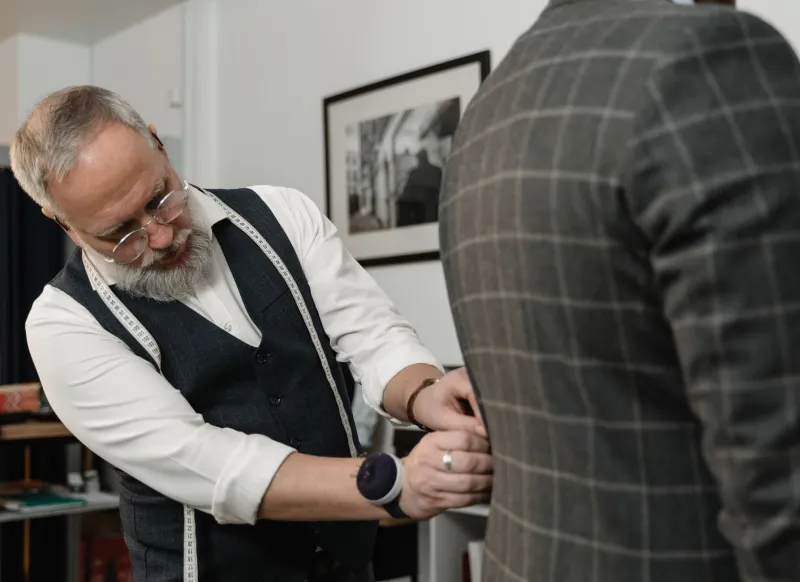
Take the shoes and the outfit you plan to wear with the garment. Say what you want in plain language: “I’d like the sleeve to show a little cuff,” or “I want the waist taken in so it sits flat at the back.” Ask for a pinned fitting before anything is sewn. A good tailor will pin, check, and tell you if a request is a bad idea. They will also be honest about cost and turnaround.
Independent tailors and alteration shops are often better value than you expect, and many will handle a batch of small jobs in one appointment. Dry cleaners can be fine for simple hems, but for anything structural, go to someone who does fittings properly.
The cost maths that keeps you honest
A £40 jacket with a £15 sleeve shortening and a £10 waist adjustment is a £65 jacket. That can still be excellent value if it fits beautifully and gets worn. But a £20 pair of trousers with a £25 alteration is no longer a bargain — it is a £45 pair of trousers that may still have cheap fabric and tired seams.
A useful rule of thumb: if alterations are under a third of the item’s price, and the garment is something you will wear often, it is usually worth considering. If they are more than half, be sceptical. The aim is not to tailor everything. It is to tailor the right things.
Ten minutes with a needle will not turn a badly made jacket into a bespoke one. But it can turn a nearly-right purchase into the thing you actually wear. That is the quiet arithmetic of a wardrobe that works: less time spent replacing clothes, more time spent wearing them.