One Glove Is Always a Design Fault: A Practical System for Winter Hands

There is a particular kind of British defeat that happens at the bottom of a coat pile on a cold Tuesday morning. You find one glove. It is a good glove. It has been loyal. But it is alone, and the other one is somewhere between the car boot, the office drawer and a bus stop in the rain. So you do what everyone does: you buy a cheap emergency pair, wear them twice, and add two more lonely gloves to the drawer by spring.
The problem is not that you are careless. The problem is that gloves are sold as accessories when they are actually infrastructure. They need a home, a drying plan and a replacement rule. Treat them like keys or reading glasses and the annual one-glove crisis becomes much less dramatic.
Two modest pairs beat one expensive pair
This is the least glamorous advice in the article, and probably the most useful. A single premium pair of leather gloves can be lovely, but if one goes missing in December you are left with an expensive orphan and cold hands. Two solid mid-price pairs — one wool or wool-blend, one weatherproof shell — give you redundancy. If one pair is wet, the other is dry. If one glove vanishes, you still have a working pair in the hallway while you decide whether to replace the missing one.
That does not mean buying four rubbish pairs. It means buying two pairs you actually like, in colours that work with your coat, and accepting that gloves live a harder life than scarves. They go in pockets, get stuffed into bags, and are pulled on with damp hands. A modest pair that fits properly and dries overnight will outperform a fancy pair that is too tight to wear on a cold walk.
The loop by the door is not a gimmick
The glove loop works because it removes the moment where gloves get separated. Put a small hook, clip or elastic loop near the door — ideally at the height of your coat hem, not hidden inside a cupboard. When you come in, both gloves go onto the loop together. Not one in each pocket. Not one on the radiator and one on the shoe rack. Together.
If you have children, give each person their own clip. A labelled loop per person is unglamorous and deeply effective. For adults, a simple carabiner through both glove cuffs works well, especially if your gloves have a small hanging loop. The point is not to create a beautiful hallway display. The point is to make separation slightly more effort than keeping them together.
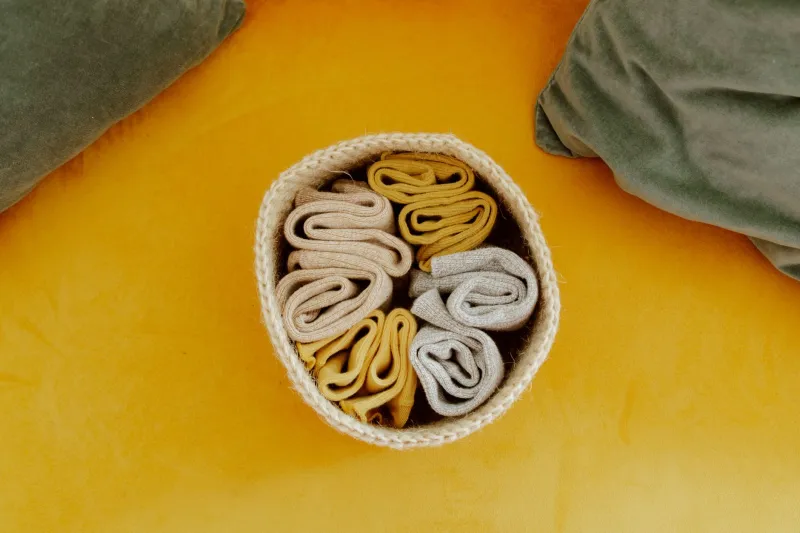
If you refuse to hang gloves by the door, use the same principle elsewhere: one small basket per household member, placed where coats actually land. The system has to fit your real habits, not the hallway you wish you had.
Touchscreen wool versus waterproof shells
Most UK winter glove decisions come down to two jobs: keeping hands warm on a dry, cold morning, and keeping hands dry in persistent drizzle. They are not the same job, which is why the two-pair approach works.
A touchscreen-friendly wool or wool-blend glove is the everyday pair. Look for a snug but not tight fit, a conductive patch on the thumb and index finger that actually works with your phone, and a cuff that covers the wrist gap. Pure wool can be scratchy for some people, so a wool-rich blend with a soft lining is often the practical choice. These gloves are for the school run, the commute and the walk to the shop.
A waterproof shell glove is the wet-weather pair. It does not need to be mountaineering-grade. It needs a sealed or water-resistant outer, a bit of grip on the palm and enough room to wear over a thin liner if it turns properly cold. Avoid bulky ski gloves for city use; you will overheat on the bus and struggle with your phone. A lightweight waterproof shell that lives in your bag from November onwards is the quiet hero of a British winter.
Dry them properly, or don't bother
Wet gloves left on a radiator become crispy, shrunken and sad. Leather gloves can crack. Wool can felt if it is dried too fast. The better routine is simple: shake off excess water, reshape the gloves flat, and dry them at room temperature with good airflow. If you have a drying rack near a radiator, use the rack — not the radiator itself. Stuffing the fingers with kitchen roll helps them keep their shape and draws out moisture.
For waterproof shells, check the care label. Most can be wiped clean and air-dried. Do not tumble dry them unless the label explicitly says so. If your gloves are soaked through every day, you need a second pair more than you need a stronger radiator.
The January replacement rule
Emergency glove buying is expensive because it happens in a panic, usually in a service station or a supermarket aisle, and usually without much choice. A better rule is to replace gloves in October, before the first cold snap, when shops still have stock and you can think clearly. Check the seams, the cuffs and the touchscreen patches. If one glove has worn through at the thumb, replace the pair — not because the other glove is bad, but because a mismatched spare is how the cycle starts again.
Keep one old pair as the genuinely rough pair for dog walks, gardening or scraping the car. That pair can live in the boot or by the back door. The good pair stays on the hallway loop.
A small glove kit that earns its keep
You do not need a drawer full of gloves. You need a working rotation: one everyday wool pair, one waterproof shell pair, and one old rough pair for messy jobs. Add a couple of spare liner gloves if you feel the cold badly, and a small mesh bag for drying. That is it. The system is boring, cheap and repeatable — which is exactly what a wardrobe essential should be.
One glove will still go missing sometimes. That is life. But with a loop by the door, two pairs in rotation and a drying routine that does not involve cooking them on the radiator, you will spend far less of January buying panic gloves in petrol stations. Your hands will be warmer, your hallway will be calmer, and the drawer of lonely gloves can finally be retired.